Wednesday, April 24, 2013

Daddy-o

The Pope in this movie goes crazy and disappears. Sad day.

I watched a really interesting movie a few weeks ago (the wife was out of town, so didn't see it with me) called Habemus Papam. It's a strange little Italian movie from 2011 about the election of a new Pope, who turns out to be pretty nuts and runs off. It's slow and tedious at times, but, for someone with an attention span like mine, mostly fascinating.

Anyway, I was struck by the sound and affect of the Italian word for Pope, "Papa." ("PAH-pah," not "pah-PAH" as we might say in Spanish). To my ear, and the way the actors said it, this was not just a title, they way "Pope" is in English, but a term of endearment. "Santo Papa!" "Papa!"

This is, it turns out, the very origin of the title "Pope" anyway. Important bishops of the ancient world, most notably Rome's, but also Alexandria's, were called, in Greek, "Pappas" by their people. "Pappas," of course, being the root of our word "Pope." The word is supposed to be more like "Daddy" or "Poppa" than a formal title for an office.

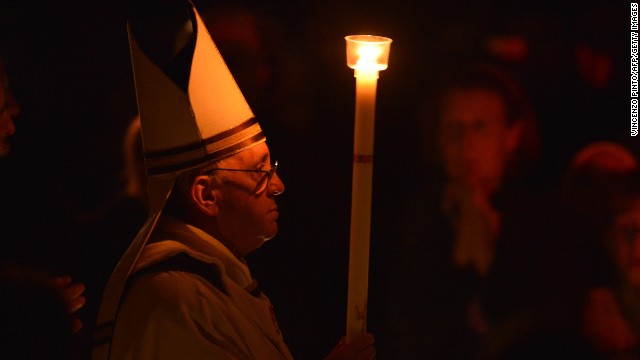
All of this is to say that I am finding it insufficient to call Pope Francis by what is in English a formal and stiff title. My heart is so full when I read his words or hear of what he does... I want something more like "Papa!"

Tuesday, April 23, 2013

Vocations for All!

Archbishop Sample always preaches with miter and crosier.
At Sunday's confirmation Mass at the university, the Archbishop, who is new Portland, spoke primarily of the Universal Call to Holiness. For him, this was the most important Vocation to talk about on the World Day of Prayer for Vocations- Holiness.

Honestly, I was pleasantly surprised.

Of course, he did mention the importance of discerning a call to priesthood and consecrated religious life. But, these particular vocations to particular states of life are always at the service of the basic, universal vocation of the baptized- holiness. Priesthood. Rulership. Prophecy.

I am just overjoyed that an Archbishop known for his conservatism and traditionalism is embracing and promoting the laity-empowering message of Vatican II. After Mass, he confessed to a group of us that he has felt personally challenged by the example of Pope Francis, challenged to live simply and humbly.

The Mission of the Church depends on the buy-in and action of the laity. We have to know that we have a mission in order to live it. That mission is holiness and we all have it.

Of course saying 'holiness' leaves a lot of room for interpretation. But, for lay Catholics to understand even vaguely that they have an important task to carry out in the world, that of offering the love of Christ to all who need it, is a step in the right direction.

My thoughts come from my own experience of confusion as a child. Although I didn't question the purpose of being Christian at the time, at least not in concrete terms, I never really understood that I had a mission to carry out in my daily life. In hindsight, it's baffling given that each Mass ends with a concrete command to "Go out and to love and serve the Lord!" I was a religiously inclined little kid (for reasons as pathological as admirable, I'm sure) and I didn't come close to getting the call I had.

Who else needs to hear that baptism is more than a membership card? I would guess most Catholics, clergy and laity alike.


Sunday, March 31, 2013

Alithos Anesti - A Reflection on Loving the New Pope

Happy Easter! Christos Anesti!

In Greece, people don't really wish each other "Happy Easter." For all of Easter Season, they say, "Christos anesti," which means, "Christ is risen." The response is "Alithos anesti," - "Truly he is risen."

A lot has been said about the new Pope. He is already beloved of Catholics of all stripes and many, many non-Catholics, too. His simplicity, humility and care for the neediest appeals to nearly everyone. Liberals and conservatives, Big church-sympathizers and members of the "creative minority," all see Christ shining through him in a remarkable way. Although perhaps not as eloquent as John Paul II or erudite as Benedict XVI, his actions proclaim Christian doctrine and morality in a way even the most brilliant encyclical cannot.

It's wonderful to see.

Let me just say, with not a little bit of shame, that I am flat-out surprised that such a beautiful soul with such a relevant message for the 21st century world could become Pope.

For years I have been been critical, often uncharitably so, of the Hierarchy. It has been hard for me to find a diocesan priest, Bishop or Archbishop who inspires me and evokes a deep sense of love and devotion. Many Catholics, I know, have felt this way. Call it my problem, not the Bishops'; that's fine with me. There are many great parish priests and bishops in the world and in this country. I think I just haven't known them. The fact remains that I have learned Christ's love, mercy, and tenderness not from the priests who've been my pastors or the bishops to whom I owe my allegiance. Instead, my relationship with Christ has been nourished by the laity, permanent deacons and members of religious communities.

From the midst of this institutional Church that has been a source of consternation and confusion for me has emerged a new light. Of course, I had never written off the institutional Church as "dead," although a lot of people had; its doctrine and work has always been more positive than negative, truer to Christ than not. Even so, the talking points, methods and priorities of many vocal US bishops had become frustrating to me as I've grown more mature in my thinking and relationship with Jesus.

In short, I'd experienced a loss of trust in my bishops and in many of the priests they'd sent to be my pastors. I hoped for a new Pope who would change the priorities of the Hierarchy to reflect more closely the priorities of Jesus and the Saints: namely, love of the poor, mercy, and compassion. Sure, there are some questions about sexuality and women's roles in the Church that I kind of hope would be taken up more fully. But, when I think of Jesus and the God I know him to be, I know that the most important issue for our time is care for the poor and suffering, not the ideological stuff that so often distracts me.

Pope Francis is already setting that as the number one priority for the Church. We find Christ in the poor and the world finds Christ in us when we care for the poor. Yes, I hope for evangelization, both traditional and "new," but my conviction for years has been that that comes about through walking the talk.

Looking at Pope Francis in his humility and ability to tear down walls to live like Christ, I am challenged to be a better person, to live the good news in which I believe. In Papa Francisco, I see Christ risen, presenting himself to the whole world. He is an angel asking us, "why do you look for the living among the dead?" Why have I been looking for Jesus among the prestige and power of the hierarchy? He's been living in the poor all along. Once again, he has breathed life into a Church that had nearly killed itself with sex scandals and self-reference.

I always love Easter. This year, though, it is not only a spiritual reality that I embrace and celebrate. My Church feels alive once more, in a way I never thought possible. I love the Pope, despite some flaws, and I would follow him where he goes, just as so many decided to follow Peter or Francis of Assisi in their time.

Alleluia! He is risen! Truly, he is risen!


Friday, October 26, 2012

Devoutly Progressive at Work

The Bell Tower and a Cherry Tree in Bloom from UP's Academic Quad
I have a full-time job, a good one. I'm the newest member of Campus Ministry staff at the University of Portland, a Holy Cross School in the same tradition as my beloved Notre Dame. It is a great place to work and a job full of challenges and creative thinking, as well as some enjoyable liturgical tasks.

Since starting the job in July, I have tried to downplay my own 'devoutly progressive' opinions in public, online places. I've been effectively on hiatus on this blog for a couple of reasons:

2.) Alienating students - I know that a minister who is too openly political with their opinions can alienate wide swaths of their entrusted flock. I don't want to turn away students from more conservative backgrounds/families/worldviews with my peace- and justice-oriented Catholicism.
3.) Self-consciousness/fear - It seems that a sort of conservative voice is dominant from the Hierarchy in this country, at least the media grabs hold of that image and pushes it down our throats. Many people equate Catholicism with conservative politics, and not without good reason. I find myself susceptible to this distortion and am afraid to speak too loudly about my own interpretation of Catholic Doctrine and New Testament Spirituality.

In other words, I'm kind of scared to publicly declare myself as decidedly not-republican now that I'm in a position of ministry. I don't want to be rejected by the dominant voice of the Church, but if that voice is getting too much amplification at the expense of my own (and others') voice, then it's time to put that fear way.

But, aside from a few personal questions which I will not discuss on this blog, nor indeed with any students, my opinions adhere closely and consistently to the Magisterium and to the US Bishops. In fact, despite all the negative press, I am proud to have been formed by the Catholic Church - it is my faith that feeds any commitment I have to the common good and social justice. I believe in a loving God who wills freedom and happiness for individuals and peace and justice in society.

That said, I am still devoutly progressive throughout my political views. What does that mean? A commitment to creating a progressively more egalitarian and inclusive society, which goes out of its way to care for the environment, provide health care and quality education, and minimize prejudice of all kinds - racial, gender, sexual, religious, economic. The government has a place in guaranteeing the equality of dignity and opportunity for all citizens. This involves continually facilitating upward mobility for the poor and marginalized and requiring responsibility from those blessed with abundance of material goods and education.

All of this is in-line with Catholic Social Teaching and, in fact, stems from it. I will do my best to make room for other opinions on economic and social issues. However, I will be up front about some things: I am pro-life in that I am in favor of federal prohibition of abortion. I am also in favor of robust social services for those who need them, including universal access to health care, however that's achieved. Finally, I am anti-war and would probably be best described as a pacifist. In my view, these issues are all complimentary and related.

My progressivism has its roots in my own deeply orthodox theological views: Jesus's example in the New Testament emphasizes that mercy and justice, together, must be priorities over all else- over profit, over ideology, over personal security.


Wednesday, May 2, 2012

Colbert V. The Jesuits

Yes, that's Paul Ryan as Big Foot.
Okay, so this video from last night's episode of the Colbert Report is too good not to share, especially given my recent obsession with the GOP Budget, as reflected on this blog. Enjoy!

Video of Stephen Colbert and Georgetown Theology Professor and Jesuit Priest Thomas Reese:


The Colbert ReportMon - Thurs 11:30pm / 10:30c
Paul Ryan's Budget - Thomas Reese
www.colbertnation.com
Colbert Report Full EpisodesPolitical Humor & Satire BlogVideo Archive

Monday, April 30, 2012

Subsidiarity

Paul Ryan loves Subsidiarity,
But doesn't seem to get the
Prefential Option for the Poor.
You've got to hand it to Paul Ryan. I think he really believes that the principle of Subsidiarity compels him to eliminate as many federal services for the poor as he sees fit. What is subsidiarity? In short, it's the belief that the best people to take care of the needy are those closest to them. The Church believes this. St. Francis believed this. Mother Teresa believed this. Dorothy Day believed this.

It is a beautiful principal, in line with the personal love that Christ displays in the New Testament and through the experience of Christian spirituality. Subsidiarity reminds us that it's not okay to just let a huge, impersonal system plug and chug with serving the needs of individuals and communities. It asks us to do everything we can to strengthen communities from the bottom up, get to know each other and take personal responsibility when a neighbor needs help. Ideally, according to subsidiarity, government would not even be necessary because we would all care for each other's needs freely and readily, leaving no one out.

Dorothy Day also loved Subsidiarity,
but prioritzed the poor, too.
Giving him the benefit of the doubt, I would guess that Rep. Ryan sincerely bases his economic proposals on this ideal. He eliminates federal spending on services with the hope that private individuals and states will pick up the slack in a more efficient, personal way.

Now, what he might not understand is that Subsidiarity requires that necessary outreach and assistance, especially to the poor and sick, be ensured. Always. It doesn't say that assistance should always be conducted on a level close to the need. It says that assistance should be conducted as close to the need as realistically possible. The question to ask ourselves, that I hope he's asked himself, is whether it's realistic that the hungry will receive better food assistance when federal food stamps are limited. Will sick children receive better insurance without federal support for Medicaid? Is there funding and man-power at state and local levels that will ensure the continuation and improvement of aid to people served by the 3.3 trillion dollars he proposes to eliminate from the federal budget?

It's not hard to see that the answer is a definitive "no!" Due to the economic crisis, states and local governments, charities and non-governmental organizations  have a far decreased capacity to assist those who need them. I am unsure how removal of federal assistance will help them to do better.

Perhaps it is theoretically possible that it will encourage donors to give more locally. However, the results of such cuts already occurring throughout state and local governments makes such a theory suspect to me. People simply don't have the extra money right now to make up for the loss of governmental assistance.

I think Ryan has misinterpreted Subsidiarity, whether willfully or otherwise. Further, he does so inconsistently, bolstering national defense with increased funding. This essentially prioritizes high-tech bombs and jets over food, education and medicine for those who desperately need it. It seems to me that he has cleaved closely to the Republican Party Platform and twisted Catholic Social Teaching to justify it.

I suppose we're all guilty, from time to time, of such twisting of our faith. However, that's why we have others to point these things out to us. The Bishops and hundreds of other faithful Catholics of all political persuasions have raised their voices to tell Catholic Republicans in Congress not to follow this line of politics. So, I hope they're going to give it a listen and change their tune accordingly.

Below is a letter from faculty at Georgetown University to Rep. Ryan regarding his misinterpretation of Catholic Social Teaching. I'm also including some other links on the topic. I'll stop posting about this budget now, I promise.

More information on the Ryan Budget here and a really good commentary here.

GeorgetownLettertoRep.PaulRyan

Wednesday, April 18, 2012

The Ryan Budget, The Bishops and the Bigger Picture

The Huffington Post has an article about John Boehner's recent dismissal of the concerns of many Catholics, specifically the US Bishops Conference, surrounding the House budget, proposed by Paul Ryan. Both Ryan and Boehner are Catholic and have been open about the fact that their faith influences their decisions as lawmakers.

For review, it proposes that the federal government spend $5.3 trillion dollars less over 10 years than we would with the current budget relatively unchanged . That's a lot of money (for some perspective, check out this illustration). The savings comes entirely from non-defense spending. In fact, it asks for an increase of $200 Billion in defense spending. Of the 5.3 trillion, 3.3 trillion (that's 62%) comes from cuts to programs we can describe as aid for low-income people. They include food stamps, medicaid and financial assistance for low-income college students. Given this, it is no exaggeration to say that the Ryan Budget disproportionately targets the poor and needy as unnecessary governmental investments.

Honestly, I don't have much of anything to add to the conversation surrounding the proposed budget, other than to add my voice to the mix. So, let me say it: it is ridiculous to cut aid to the poor and sick without asking the well-off to make any additional sacrifices at all. Actually, many corporations and wealthy individuals will find  lower tax rates. This is all, sad to say, something I expect from the Republican party, a case of backwards priorities.

What's different, however,  is that Rep. Ryan has had the audacity to appeal to Catholic Social Teaching as the inspiration for his plan. This dynamic is further exacerbated by the public disapproval of the Bishops, followed by Speaker Boehner's blunt dismissal of their concerns.

Catholic priorities, articulated by both the Institutional Church and in evidence through the Church's history, have always began with assistance for the vulnerable. Further, the Church expects government to use its resources effectively to protect and nourish the worst-off in the nation. This principle and expectation explains the vocal opposition to legalized abortion, the death penalty and euthanasia. This same set of values, a preferential option for the poor and vulnerable in Catholic-speak, demands a budget that whole-heartedly supports services for the poor.

From where I sit, lawmakers who prioritize corporations and wealthy individuals so blatantly are, at best, fooling themselves and, at worst, intentionally favoring the powerful over the voiceless.

Anyone who hasn't heard, open your ears! While Republicans claim to value life above all, they refuse to use the government to protect anyone but the unborn and the well-off. Further, this budget proves that, when there are "tough choices" the poor lose where bombs, fighter jets and the companies that make them win.

Jesus told us that we will always have the poor. He also told us to be with him while we could. In Matthew he drives the point home by telling us exactly where his is: with the hungry, naked, imprisoned and sick. Now, who knows whether this budget will become law. But, we must live as people both of direct action and political power. We must take care of the needs of the poor through charities and non-profits but we must also ask for help on their behalf, finding ways to empower businesses to hire people and maintain assistance for those who will go hungry without it.


Wednesday, March 7, 2012

Embodying the Prophets

Dr. Walter Brueggemann
Last weekend, I had to opportunity to see Dr. Walter Brueggemann present at The Justice Conference. We read one of his books in my Old Testament Prophets class at Notre Dame, one of his most famous works, The Prophetic Imagination. Hearing him speak brought all the memories and themes of my Prophets class back like a flash flood. I was overwhelmed by how passionate and articulate (not to mention charming and good-natured) he was. He also elegantly connected the message of the Prophets to the message and person of Jesus. Further, he found clear ways to apply that message to our lives, both as a society and as individuals.

For now, I really just want to report on some of the insights he shared with that room of 2000, mostly Evangelical Christian, people.

First, he dove into 5 words in the book of Hosea God uses to describe his love for his people. Steadfast love, righteousness, justice, compassion and self-giving love. These words are all rough synonyms for the kind of fidelity God pleges to Israel, comparing himself to a spouse.

He emphasized that God's love is described as a 'gut-wrenching' kind of love in both Hebrew and Greek. It made me remember that the word for compassion used in the Magnificat in Luke is related to the word for entrails. For God, love is visceral, intense. It requires a response.

His response? Jesus. I was so taken with the way Brueggemann described Jesus as the literal embodiment of God's love and promises made in the prophets. He drove his point home by reminding us of one of John the Baptist's communications with Jesus: "Are you the one who was to come...?" His followers asked Jesus. Brueggemann noted that Jesus, rather than giving a straight answer, he describes what he's seeing: "The blind see, the lame walk, lepers are cleansed, the deaf hear... the poor have Good News proclaimed to them."

Brueggemann's idea is that Jesus wasn't just being enigmatic, but that he was saying, "Look, I don't know any better than you, but wherever I go, the stuff the prophets said comes true." Jesus knew that gut-wrenching compassion and he couldn't help but do something about it! He became a radical conduit of love and healing for the world.

The conclusion? We must seek to love in a visceral, gut-wrenching way, like Jesus did by His own nature. Such love will always prompt action, will always lead us to heal and to proclaim good news. It is our response to God's gift of fidelity to us.

Monday, February 6, 2012

Simply Living

So, I'm finally living more simply.

Since I was 20 and spent a summer at a lay Catholic agricultural community I have talked and thought about 'simple living' a lot. Let's define it as this infectious idea that happiness and justice will come when we get rid of all our stuff and focus on God and each other. It's an idea that's truly scriptural. "Foxes have dens and birds have nests, but the Son of Man has no place to lay his head." Jesus focused on his disciples and his ministry in such a complete way that he didn't seem to own really anything but the shirt on his back and the sandals on his feet. Many of the Saints after him, from St. Paul to St. Martin Francis of Assisi to Servant of God Dorothy Day, continue this example for us, helping us to see what it might mean in our time and place. They do everything from giving up wages and living on the road to refusing to touch money to opening up a house where nearly everything is owned by everyone who walks in the door.

Now, we could get into questions of extreme simplicity and unhealthy self-deprivation. And, I probably will delve into my interpretation of such scriptural and hagiographal examples at a later time. For now, let's just say that today many of these examples translate into recognizable efforts at intentionally saving money, space and energy. There's a lot of canning and gardening and buying used items. You'll find people who've thrown out their TVs and still use the most basic cell phones on the market. They knit their own socks and blankets and compost whatever they can. They get rid of many of the luxuries we come to expect in favor of doing things themselves, getting closer to the earth and spending more quality time with others and God. For years, I've been totally down with this idea. It seems to me to be good for us as individuals, good for communities and good for the environment.

I never truly made much progress in that arena on my own- I own a car, have some debt, a smartphone, a blu-ray player, tons of kitchen stuff, a spare bedroom, a nice laptop... a lot of things that make my life complicated all the time. However, now that I am married and working only a 12 hours a week, there are many ways in which I'm living more simply than ever. This is not, unfortunately, completely by choice. We simply can't afford to buy all of the distractions in which we might otherwise indulge.

We both love traveling and going out to eat. Since I was probably 18 I'd taken for granted the ability to travel a lot and go out to eat multiple times a week. On a budget like ours, those days are no more! I'm learning all kinds of new recipes, just to ensure that there's plenty of variety at dinner. I'm drinking hardly any beer (and, when I do, it's usually beer I've made). And when we go out, we stick close to home, getting to know all the nooks and crannies of Northwestern Oregon. Soon enough, we'll be composting and gardening to conserve even more money.

When we're not worried about how to pay the bills, it's actually pretty nice. I find I love riding the bus; a trip down Martin Luther King Ave in East Portland is about as much of an education for me as many of my classes at Amherst were. The highlights of my day now include cooking for Angie, curling up beside her on the couch with a book and playing with our two cats. They are, I admit, simple pleasures. But they are things that draw me closer to her and to my surroundings. If I drive myself to work, I'm as likely to arrive there angry and anxious as not. But, I've never gotten road rage on the bus. Much of what remains is mostly distraction- Hulu and Netflix and Amazon Prime, smartphones and iPods. It all makes it easier for me to tune out the problems both within myself and the world around me, numbs the pain a bit. If I'm distracted, I'm also out of touch and useless to myself and to the world around me.

Living simply, even if starts as a necessity, saves us from some unnecessary frustrations and focuses us on the people and things around us, which tend to be the people and things that are most real, that need us the most.

I hope to continue a trend toward living more simply, even in the future when paying the bills is a bit easier (hopefully soon). Let it show me how to be more loving at all times.


Monday, January 23, 2012

Voting Democrat

Now, given the choices in our political process, I nearly always vote for the Democrat. I'm never really 100% sure whether it's the right thing to do.

For some Christians it's cut-and-dry: Does the politician support Abortion rights? If yes, no votes. If no, then it might be okay to vote for her. If only I were able to think this way! My political life would be somewhat easier, at least my choice of candidates would be. I would feel less pain when submitting my ballot.

But, for better or for worse, I vote for the politician whose policies I deem to be more protective of the overall common good and, I'm ashamed to admit, can get a little utilitarian in the process. I had 8 years of a 'pro-life' president through my most politically formative years. Abortion was legal at the beginning of his administration and remained so by the end, though instances of abortion may have dropped in the early 2000s. The Morning After Pill, which seems to be an abortifacient, was introduced and legalized. A culture of war and fear grew. Economic inequality widened. If abortion law wasn't going to effectively change under a Republican president or congress, then why put up with all the other garbage they bring along?

But, sometimes, in the face of millions of unnecessary deaths caused by abortion, these things seem small- too small. Sometimes, I lie awake at night and think of how I'm not using my vote to send a message to the Democratic party. Am I trading support of unions, minimum wage, health care access, international peace and good diplomacy for the lives of the unborn? Would voting republican be more consistent with my conviction that life begins at conception?

A pro-life candidate who considers food stamps and welfare for single mothers to be an enabling handout is not helping the pro-life cause. Someone who truly believes that the Marketplace will somehow magically strengthen the moral and economic power of poor families needs to remember the industrial revolution, child labor, sweat shops and 7-day work weeks. Abortion is, in part, a response to the incredible suffering and hopelessness caused by economic and social injustice. It is also rooted in a sick view of sexuality and human life, one that is not helped by examples of philandering politicians, warmongering, the death penalty or victim-blaming.

In my view, neither party offers a cure for the sickness of abortion. On one hand, I see a party that wishes to prohibit Abortion but deny that families need help from a government. On the other, I see a party that wants to take concrete and direct action to create a more peaceful and just society but leave the definition of life up to  the individual. Do I vote for the hope of systemic change or for the hope of prohibition?

In the end, my answer is to look at the larger picture- single-issue voting just doesn't sit well in my heart, although if I were to vote with the Single Issue in mind, my choice would be simple. Perhaps one day I will.

Guide us, Lord, to an end to legal abortion and raise up more progressives who support its prohibition. Amen.


Sunday, March 14, 2010

Today I sat in the Florida sun, in a parishioner's backyard, eating some kind of spicy West African barbecue and corn meal paste, listening to 6 happy Togolese banter loudly in a language I've never even heard, while children did cartwheels in the yard, loud and festive Haitian (?) music playing. It was incredible, one of the best moments of my ministry at St. Jude's. 
The couple who threw the party had their marriage convalidated today so that the woman will be eligible to receive the Sacraments of Initiation at the Easter Vigil. They are two of the loveliest people I've met. Her husband was received into the Church in Togo 15 years ago. She has been attending Mass with him for years now and has finally decided to be baptized. They have a daughter who is four and absolutely adorable. After RCIA class this morning, we had the wedding ceremony and a group of their friends from different parts of Florida were in attendance. They invited me to come for the celebration and, fortunately, I didn't have plans for lunch. 
The warmth of hospitality was almost unreal. I was greeted by both at the door and my cup and plate were kept full as long as I was sitting (despite my protests!). I'm still full.
This surprise of a moment gives me a little hope for our Church. These two are extremely faithful and will without a doubt be active in the parish. He is even talking about the diaconate. If these two can find a place for their hospitality at St. Jude's, then they will be contributing a great deal to the life of the parish. All I can do is my best to extend my hospitality to them now, put them in contact with the right people and pray. If that kind of party- simple and joyful and hospitable- could be present in our churches, then we would be a much happier, healthier worldwide Church.

Monday, January 18, 2010

Celebrating Mass

One of my earliest memories is Mass. I am no older than two. My Grandmother and Aunt and I sit near the back of a long nave, the muted cold grays and whites of the church in San Leandro amplifying the echo of the celebrant's voice. My attention, of course, is not focused on the organist, who begins to lead the congregation in a hymn. Aunt Norma beckons me to quietly sit down. Her pink and frilly dress contrasts sharply next to the dark wood of the pew.

Why should I sit?, I ask myself. I rush to the arm of the pew to get a better glimpse of the action. A guitar takes the place of the organ and a small group of people walk jubilantly down the long and wide center aisle. I am attracted to their bouncy gait, their smiles and, most of all, the baskets of food and drink in their arms. “Look!” I whisper loudly to my Grandmother, pulling her hand so she can see what I see. It is obvious to me what this is- food, music, families, a happy-looking man dressed in fancy clothes; we are at a party. 

“Anthony, you have to sit down and stop talking,” hisses my aunt. My frustration is unutterable at that moment. Not only am I disallowed to join that procession of joyful people and revel in the food they're bringing, but I seem to be the only one who understands what kind of event we're at. I want to dance, to jump and enjoy. Grandma and Aunt Norma could not be more serious, could not be less fun.

This first memory of church didn't seem significant or interesting to me until fairly recently. Now I suspect it is a grace-filled gift that reveals the deepest and strongest portion of myself and, perhaps, of all people. This memory never left me, always coloring my view of church and religion in a specific way: confusing, mysterious, joyful, exciting, festive, frustrating. As a toddler, I was able to react genuinely to the liturgy constructed for me to attend with my family. The movement from speaking to music, from distant preaching to wordless participation, the simple presence of food- these things stoked excitement in me. Almost like an illness, I unconsciously caught  the feeling of the Mass. As a two year-old, I had no concept of appropriate expression. I didn't know that my Aunt's gravity was her way of honoring the holy. All I knew then is that it stifled me and kept me from eating with the rest of the people.

It is obvious to even a two year-old that Mass is a celebration. But, how often do we find a spirit of celebration at our liturgies? In a world of noise, busyness, tasks and pain, silence is a respectful and healing response to the Holy. But it is the response of a wounded people, a people who find a humiliating chasm of sin when they approach God. Today, I find myself more comfortable in the silence of a chapel than in a noisy room. But, the two year-old Anthony wants nothing more than to turn the echoing silence into a feast, to dance and sing and jump and shout about how fun it all is. My experience of Christ, a God who becomes man to cross that chasm of sin, emboldens this desire. This desire is who I am, a creature made to rejoice and praise. It also reveals how much closer to my purpose I was 21 years ago. But, just as this memory never left me, neither has the deep sense of longing, restlessness, frustration, joy. And neither has it left anyone else, not completely.

Thursday, December 31, 2009

Seeking Visitation

One of the benefits of my work in parish religious education is hearing scripture repeatedly. Seriously, coordinating the RCIA class has forced me to read and re-read and then read again every Sunday Gospel reading each week. . I read and make copies of the Gospel excerpt on Friday to prepare for class, go to Liturgy of the Word with the Catechumens on Sunday morning, lead them in a close reading of that excerpt for the first half hour of class, then attend Mass for myself later that day. All in all, I can count on four or five different encounters with the same Gospel reading each and every weekend. The wonderful thing about Scripture readings, though, and the Gospels in particular, is that they lend themselves to such repetition. The archaic and often awkward translations, the opaque parables and stories, Christ's dynamic and multi-layered sermons- each reading really requires the kind of attention that I am forced to give for work. That's attention that I definitely wouldn't give otherwise.

The day before I left Florida to visit family in Northern California, the Gospel was Luke's iconic account of the Visitation of Mary to her cousin Elizabeth. The beauty and mystery of this story had struck me many times before. But, it had never felt so personal to me as it did that day, around about the third encounter with the excerpt. For weeks I had been anticipating my first visit home in months, a long trek to celebrate the same birth Luke writes about. Mary and Elizabeth's joyful reunion was the same reunion I would have the very next day, 2008 years later. Certainly, Christ had grown in me since the last time I'd seen the people of my childhood. Certainly, I could try to bring them the great honor of the Incarnation just as Mary did for Elizabeth. I was excited and overjoyed for the affection, care and genuine love experienced in the Visitation. But something felt wrong about identifying so strongly with the Mother of God.

At Mass later that day, I was subject to one of the worst homilies I've ever heard. This gave me the opportunity to further reflect on my own discomfort with the prospect of bearing Christ to my family and friends during my two-week vacation. Was it impious to think of myself so highly? Surely, I am not Mary. I'm not her holy cousin either, faithful enough to bear the fore-runner of Christ in her old age. I am not the conduit of prophetic utterances as meaningful or faithful as the Magnificat. Was I being condescending? Here I am, the Masters in Theology student from Notre Dame come home to teach my family and friends a thing or two about love and Jesus and Christmas.

I am definitely condescending. In a bad way. The meeting of Mary and Elizabeth is the meeting of two equals, two individuals who admire each other and love to spend time in the presence of one another. In fact, if anything, it is the story of a desperate young girl going to her older cousin for help while she sorts out her apparently illegitimate pregnancy. Identifying with Mary is necessary for growth as a disciple, but her amazing virtue and power is reinforced by her frank humility- sometimes she needs help. I, too, weary and angry from a difficult time at work needed help from my friends and family. Sure, I wanted to help them grow in faith and love of Christ, but part of that would involve being honest and open and as weak as I am.

The Visitation is about mutual human love and support, for Mary will certainly be comforting to her older cousin. Reunion is a time to hear about another and to share my story, and I've found that my dearest friends are wildly successful in providing this mutuality. I am impious for hoping to be as virtuous as Mary? No. I'm impious for not challenging myself to be. My close friends, though I don't see most of them very often, make me think and help Christ to grow in me. I, too, bring my experience to them and lovingly help them to find the baptist within. This is not something that comes easily to a grumpy, cerebral and condescending grad student. But living the radical love of the Incarnation means trying to be as good at Mary is to Elizabeth, while being humble enough to ask help of those who are in need too.

Now, I'm getting ready to leave family and friends again. I don't feel like I've brought anything to my family, especially not the incarnational love I'd hoped to be able to. I've been difficult and grumpy at times. I've fallen into bad habits from my teens and flaked out on some visits. I think, though, that my visit and the lack of satisfaction I feel from it gives me a stronger commitment to make each encounter I have a Visitation.

St. Elizabeth, pray for us.

Sunday, December 27, 2009

A New Endeavor

Lately, I have had a desire to write again. For years, I was regularly reflecting and writing for others to read, namely professors, sometimes classmates. Today, I'm reflecting plenty but writing little. I think I've grown apart from Livejournal and my college blogging site (which is closed to the public). In order to keep up with practice, I'm creating this space for myself. As I attempt to apply theological thought to the world around me, I hope others will comment with their own reflections and ideas. Or perhaps this will be an echo chamber.

To catch up, please see my last sustained attempt at a blog: dallaspaz.livejournal.com. It's mostly a filtered diary. I hope my posts on this blog will be generally more thoughtful.

Merry Christmas. St. Francis de Sales, patron saint of writers, pray for me.